
If the text below appears truncated or otherwise improperly presented, load the original copy.
Many of the teenage students I encountered seemed to be in a state of what I would call depressive hedonia. Depression is usually characterized as a state of anhedonia, but the condition I’m referring to is constituted not by an inability to get pleasure so much as it is by an inability to do anything else except pursue pleasure. There is a sense that ‘something is missing’ – but no appreciation that this mysterious, missing enjoyment can only be accessed beyond the pleasure principle.
Mark Fisher[1]
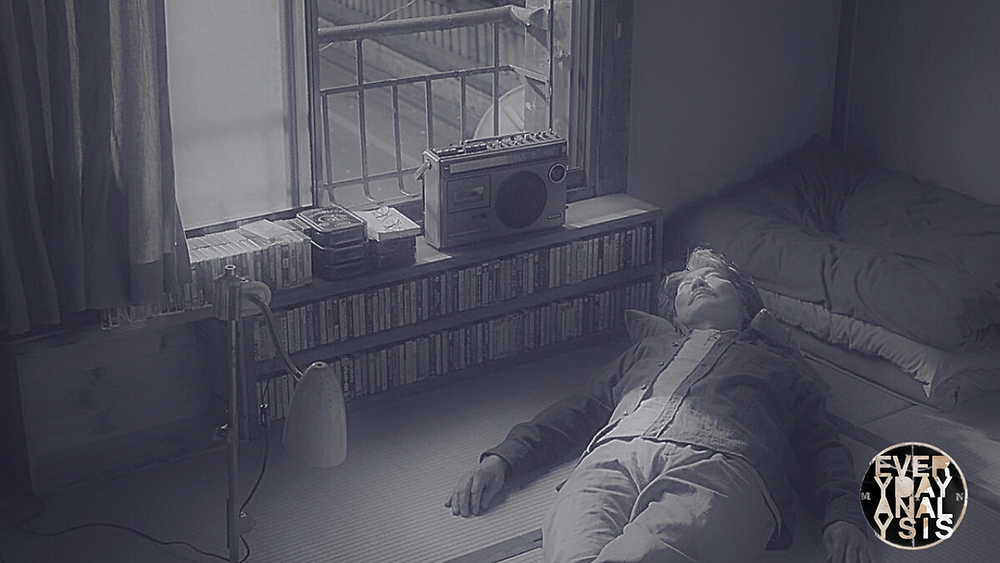
Perfect Days (2023), a film by Wim Wenders, tells the story of Hirayama (Kōji Yakusho), a middle-aged man in Tokyo employed as a public toilet cleaner. He commences each day at dawn, brushing his teeth, cultivating his plants, and selecting cherished cassette tapes for his daily commute. Hirayama treats cleaning public restrooms as an art form, approaching his work with pride, precision, and meticulous attention to detail to make each space spotless and inviting.
Outside of his work, Hirayama enjoys the simple pleasures of life: reading Faulkner, photographing trees, and basking in moments of solitude. He is a man of routine, few words, and sparse human connections.
As I watched Hirayama’s life unfold before my eyes, I could not help but think of my autistic clients. I work as a psychotherapist, focused on helping autistic men and women navigate the complexities of modern existence. Like Hirayama, my clients thrive on routine, prefer solitary activities to socialization, and develop special bonds to treasured objects.
Hirayama’s refusal to align with societal expectations resonates with the way my autistic clients value strict routines, find deep satisfaction in solitary pursuits, and prefer authentic self-expression over social conformity. Like my clients, Hirayama fashions a life that aligns with his internal sense of order and meaning, rather than succumbing to external pressures.
Hirayama’s quiet defiance of societal norms, just like my autistic clients, highlights the radical embrace of his singularity and serves as a foil to neoliberal self-optimization.
Mari Ruti and Gail M. Newman describe the pitfalls of neoliberal subjectivity in The Creative Self: Beyond Individualism[3]. The authors claim that for the individual in a neoliberal society, self-optimization is the normative mode of being for work and personal life. Self-optimization refers to “the attempt that many people make to constantly improve their performance and efficiency[4]”.
Ruti labels the cruel optimism of perpetual self-optimization the performance principle. Under the performance principle, neoliberal subjects exhaust themselves by constantly seeking to improve and achieve.
Instead of leading to satisfaction and fulfillment, life under the performance principle leads to what Mark Fisher labels depressive hedonia. This is not depression where one cannot experience pleasure, but a depression where one cannot stop pursuing pleasure.
Ruti draws on philosopher Frederich Nietzsche to sketch a vision of subjectivity beyond the performance principle. According to Ruti, “many of us are looking for a meaningful, imaginative, creative, and possibly slower way to live—that we want to actively participate in the fashioning of our destiny[5]”.
This poetics of being, “accentuates the uniqueness of our being- our inimitable ‘style’- even when this uniqueness defies conventional social dictates[6]”.
Marion Milner (1900–1998) was a British psychoanalyst, psychologist, and writer known for her pioneering work in exploring creativity, self-expression, and the inner life.
Ruti reads Milner’s search for worldly transcendence in light of Jaques Lacan’s understanding of sublimation. According to Lacan, sublimation is the raising of an ordinary object to the dignity of the Thing.
Singularity, for Ruti, is cultivated in the space of solitude. Solitude provides a temporary respite from the unrelenting demands of upholding a socially intelligible individuality.
Hirayama’s singularity is a celebration of creative living as an antidote to the normative demands of neoliberal society. In his solitary and quiet existence, he connects with his private sea and there finds deep joy as well as sorrow and unrequited love.
[1] Fisher, M. (2009). Capitalist realism: Is there no alternative? Zero Books.
[3] Ruti, M., & Newman, G. M. (2025). The creative self: Beyond individualism. Columbia University Press.
[4–10] Ruti and Newman, The Creative Self, 2025.